How to Choose the Right Home Gym Equipment for Your Fitness Goals
You start by pinpointing exactly what you want to achieve—strength, endurance, mobility, or a mix—and then map those goals to equipment that delivers progressive overload and programmable resistance. Next, measure your available floor space, accounting for clearance around each piece. Set a realistic budget, favoring multi‑functional gear that can grow with you. Finally, weigh the trade‑offs between free weights and machines to match your training style. This framework will guide every subsequent decision.
Define Your Fitness Goal and Choose Home Gym Equipment
What’s your primary fitness objective? Begin with a thorough fitness assessment: measure strength, endurance, flexibility, and body composition using calibrated tools or validated apps. Record baseline metrics, then translate data into precise goal setting.
Identify whether you aim to increase maximal load, improve cardiovascular capacity, or enhance functional mobility. Map each objective to equipment categories—barbells for strength, rowing machines for endurance, resistance bands for mobility.
Map goals to gear: barbells for strength, rowing machines for cardio, resistance bands for mobility.
Prioritize items that enable progressive overload and programmable resistance, ensuring they align with your spatial constraints and budget. Create a selection matrix listing equipment, required load range, and compatibility with your training plan.
Validate choices by simulating workout cycles, confirming each piece supports the defined goals without excess or redundancy.
Measure Your Space for Home Gym Equipment
After pinpointing your fitness objective and matching it to equipment categories, you need to verify that your available area can accommodate the chosen gear.
Start by measuring the room’s length, width, and ceiling height with a laser distance meter; record these space dimensions in centimeters or inches for precision.
Sketch a to‑scale floor plan on graph paper or a digital app, then plot each piece of equipment, accounting for clearance: at least 60 cm for movement, 90 cm for barbell racks, and 120 cm for cardio machines.
Test layout optimization by rotating items, ensuring you can access power outlets and maintain airflow.
Verify that doorways and stairwells can accommodate the largest item before purchase, preventing costly re‑configurations.
Set a Budget for Home Gym Equipment and Pick Multi‑Function Pieces
Start by defining a realistic total spend—typically 5 % to 10 % of your annual household income is a solid benchmark for a home gym.
Calculate your budget considerations by listing essential categories: cardio, strength, and accessories, then assign percentages based on your training priorities.
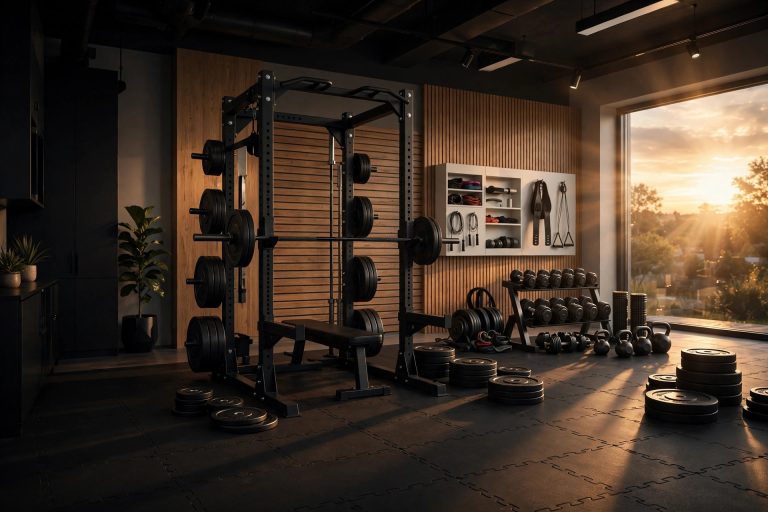
Prioritize multi‑function benefits to maximize floor space and dollar value; a power rack with integrated pull‑up bar, dip station, and plate storage replaces several single‑purpose units.
Evaluate adjustable dumbbells, foldable benches, and resistance‑band stations for their ability to support diverse exercises while staying within your financial envelope.
Cross‑reference each item’s cost against its versatility score, eliminating redundancies.
Finally, verify that total projected expenses remain under the defined spend limit before finalizing purchases.
Compare Home Gym Strength Equipment: Free Weights vs. Machines
You’ll notice that free weights let you perform a broader range of movement patterns, engaging stabilizer muscles and allowing incremental load adjustments.
Machines, on the other hand, constrain the motion path, which reduces the risk of improper form and isolates target groups more reliably.
Evaluate your training goals and safety preferences to decide which option—or combination—best fits your home gym setup.
Free Weights Versatility
When you prioritize functional movement patterns, free weights outshine machines by engaging stabilizer muscles and allowing multi‑plane actions, so you can replicate real‑world lifts and improve overall strength coordination.
In strength training, dumbbells and barbells enable you to adjust load, grip, and range of motion on the fly, fostering muscle endurance and workout variety without preset constraints.
The free‑weight environment demands balance improvement and core stability, which translates to functional fitness gains and mobility enhancement.
By loading each side independently, you reduce asymmetry, supporting injury prevention and joint health.
Incorporate compound lifts, unilateral presses, and dynamic swings to challenge proprioception, expand movement patterns, and keep sessions adaptable to evolving goals.
Machine Guided Safety
Free‑weight routines demand constant attention to form, which can increase injury risk for beginners; machines mitigate that by providing guided motion paths and built‑in safety stops.
When you select a machine, examine its mechanical lockout system, adjustable range‑of‑motion stops, and weight stack interlocks—these features constitute core machine safety.
Verify that the pin‑release lever engages smoothly and that the weight selector prevents accidental overload.
For guided workouts, choose equipment with programmable resistance curves, allowing you to pre‑set intensity and maintain consistent tempo.
Align the seat and lever positions to your anthropometry, then lock the safety catches before each set.
This precise alignment reduces joint strain, lets you focus on progressive overload, and preserves freedom to train without constant supervision.
Cardio Options for Home Gym Equipment
You should evaluate compact treadmill models for their motor horsepower, belt length, and incline range to match your space and training goals.
Next, compare foldable rowing machines by examining frame stability, resistance type, and storage dimensions.
Finally, assess adjustable ellipticals for stride length, resistance levels, and integrated monitoring features to guarantee they fit your cardio routine.
Compact Treadmill Choices
Ever wondered how a compact treadmill can fit a tight living space while still delivering robust cardio performance? You’ll need to evaluate compact treadmill features like motor horsepower, deck thickness, incline range, and noise level, then match them to reliable compact treadmill brands that guarantee durability and warranty support.
Prioritize models with fold‑up frames, transport wheels, and quick‑release handles to maximize freedom of movement in your home gym. Measure your floor area, check voltage requirements, and verify Bluetooth or app integration for data tracking.
- Motor power ≥ 2.5 HP for steady jogging
- Deck length ≥ 45 in for natural stride
- Incline range 0‑10% for varied intensity
- Noise ≤ 65 dB for shared spaces
- Foldable frame with lock‑out safety
These specs assure you stay fit without sacrificing space.
Foldable Rowing Machines
Looking to squeeze a full‑body cardio workout into a cramped apartment? A foldable rowing machine delivers high‑intensity training while preserving floor space.
Choose a model with a compact design that folds vertically and locks securely, reducing storage depth to under 30 inches. Verify that the resistance system—magnetic, air, or hydraulic—offers smooth, adjustable levels and that the flywheel is enclosed to minimize noise.
User friendly features such as a clear LCD console, Bluetooth connectivity, and preset interval programs let you track splits, calories, and heart rate without extra gear.
Check the handle grip ergonomics and foot‑strap adjustability to maintain proper posture.
Finally, confirm the frame’s weight capacity exceeds your body weight by at least 20 lb for safety and longevity.
Adjustable Elliptical Features
When space is limited but you still want a full‑body, low‑impact cardio workout, an adjustable elliptical can provide the versatility you need.
You’ll focus on adjustable resistance, ergonomic design, stride length, incline range, and connectivity options. Choose a model that lets you dial resistance in 1‑step increments, ensuring progressive overload without bulky plates.
The ergonomic design should cradle your hands and align hips, knees, and ankles to prevent strain. A configurable stride length accommodates tall and short users, while a smooth incline mechanism expands muscle engagement.
Finally, integrate Bluetooth or ANT+ for data syncing, enabling you to track metrics and maintain freedom in program selection.
- Adjustable resistance dial with 1‑step increments
- Ergonomic hand grips and footplates
- Adjustable stride length (15‑20 in)
- Incline range up to 15°
- Bluetooth/ANT+ connectivity for apps
Add Flexibility and Recovery Tools to Your Home Gym Equipment
If you want your home gym to support both performance and recovery, integrate flexibility and recovery tools alongside your strength equipment. Choose foam rollers for myofascial release, resistance bands for dynamic stretching, and a high‑density stretching mat for floor work. Add massage balls to target trigger points, yoga blocks to deepen poses, and a stability ball for core activation and joint mobility.
| Tool | Primary Use | Placement |
|---|---|---|
| Foam Roller | Tissue release | Near weight rack |
| Resistance Bands | Stretch & activation | Hooked to door frame |
| Stretching Mat | Floor mobility | In corner space |
| Massage Balls | Trigger point work | On shelf |
| Yoga Blocks | Pose support | Adjacent to mat |
| Stability Ball | Core & balance | Against wall |
These items expand functional range, reduce injury risk, and preserve the freedom to train anytime.
Future‑Proof Your Home Gym: Expansion & Maintenance
Integrating flexibility and recovery tools sets a solid foundation, but a future-proof home gym must also accommodate growth and sustain performance over time.
Apply future proof strategies now: choose modular racks, install reinforced flooring, and select equipment with interchangeable parts.
Prioritize regular inspection and calibrated maintenance to boost equipment longevity. Use a systematic schedule for lubrication, bolt tightening, and software updates on smart devices.
Document every adjustment in a digital log, so you can troubleshoot quickly and avoid costly downtime.
- Modular power rack with adjustable height and accessory ports
- Heavy-duty rubber flooring with interlocking design
- Multi-function bench that converts to a squat rack
- Smart cardio machine with firmware upgrade capability
- Wall-mounted storage system with expandable hooks and shelves
Frequently Asked Questions
How Often Should I Replace My Home Gym Equipment?
Do you know when equipment lifespan ends? Replace gear every 5‑10 years, or sooner if you notice signs like rust, wobble, worn cables, or reduced resistance—ensuring safety and performance for your freedom‑driven workouts.
Can I Combine Home Gym Gear With Outdoor Workout Tools?
Yes, you can merge home gym gear with outdoor tools; focus on outdoor synergy and equipment versatility, ensuring each piece integrates safely, balances load, and supports progressive, unrestricted training across environments.
What Noise Level Is Typical for Different Cardio Machines?
You’ll find treadmills around 70‑80 dB, ellipticals 65‑75 dB, stationary bikes 60‑70 dB, and rowing machines 55‑65 dB; compare these noise levels and sound levels to match your desired freedom and space.
Do I Need a Professional to Install Multi‑Function Equipment?
You probably don’t need a professional, but follow installation tips carefully; if the equipment’s weight-capacity or wiring seems complex, seek professional advice. This guarantees safety, performance, and the freedom to train confidently.
How Can I Ensure Equipment Safety for Children at Home?
Secure the area by applying childproofing tips: lock moving parts, cover cables, and use safety straps. Position equipment away from play zones, keep it anchored, and install clear barriers to prevent accidental access.