Treadmill vs Exercise Bike: Which Cardio Machine Is Better for Home Workouts?
Imagine a tug‑of‑war between impact and convenience, and you’ll see why the choice isn’t trivial. You’ll weigh the high‑intensity, weight‑bearing stride of a treadmill against the low‑impact, space‑saving spin of a bike, each backed by data on calorie burn, joint stress, noise, and cost. Your fitness goals, living quarters, and budget all tip the scales, and the nuances of HIIT, endurance, and tracking features add layers to the decision. Ready to see which machine truly aligns with your home workout needs?
How Do I Decide Between a Treadmill and an Exercise Bike?
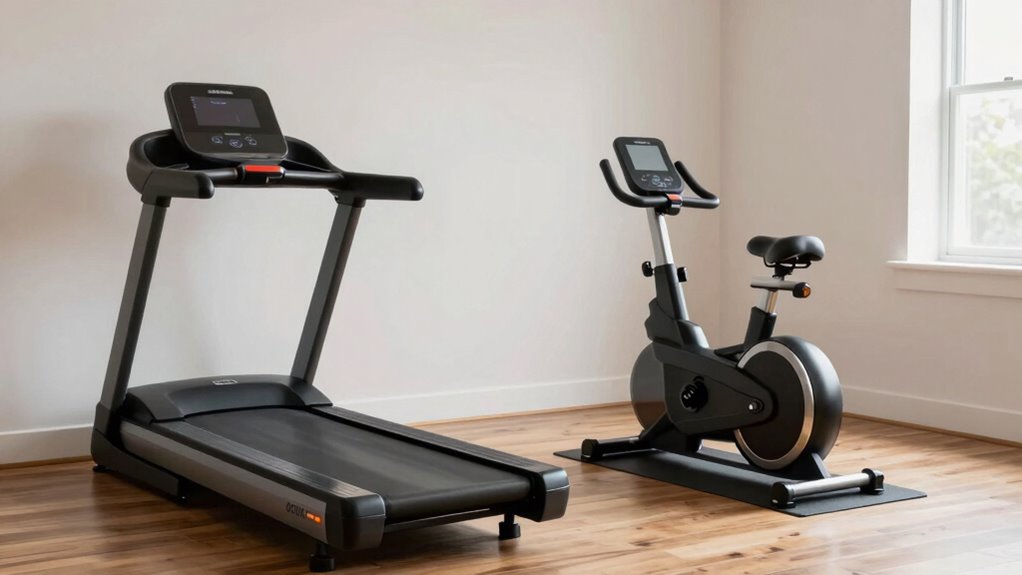
How do you choose between a treadmill and an exercise bike? You start by mapping your workout goals to each machine’s strengths. If you aim for high‑intensity interval runs, weight‑bearing cardio, or training for a race, a treadmill delivers the impact and speed control you need.
Map your workout goals to each machine’s strengths for a tailored cardio choice.
If low‑impact endurance, joint protection, or cycling‑specific performance matter, the bike excels.
Next, assess space requirements: a compact fold‑up treadmill occupies roughly 30‑40 sq ft when unfolded, while a sleek stationary bike fits within a 20‑sq ft footprint and often folds flat.
Compare power draw, noise levels, and warranty terms, then match the device that aligns with your freedom‑driven lifestyle, budget, and the room you actually have.
How Do the Workout Mechanics Differ?
When you compare the mechanics of a treadmill and an exercise bike, the key differences lie in how each device engages your muscles and joints.
On a treadmill, you bear full body weight while your legs propel you forward, producing a natural gait that stimulates the quadriceps, hamstrings, glutes, and calf muscles in a weight‑bearing pattern. The impact forces also recruit stabilizing muscles around the ankles and core, raising workout intensity for those who thrive on dynamic, high‑impact movement.
In contrast, an exercise bike isolates the lower limbs in a seated, non‑weight‑bearing position, emphasizing concentric and eccentric contractions of the same muscle groups but with less joint stress.
Adjusting resistance and cadence lets you fine‑tune muscle engagement and intensity, offering a controlled, low‑impact experience that preserves joint health while still delivering a solid cardio challenge.
Which Machine Burns More Calories per Minute?
Wondering which machine torch more calories per minute? The answer hinges on exercise intensity, body weight, and how you engage each device.
Studies show a treadmill at a brisk 6 mph can reach 10–12 kcal/min for a 155‑lb person, while a high‑resistance bike at 80 rpm averages 8–10 kcal/min. Your personal effort level matters: hill intervals on a treadmill spike caloric burn, but sprint intervals on a bike can match or exceed it if you push the resistance.
Choose the machine that lets you sustain your preferred intensity without feeling trapped, and you’ll maximize calorie expenditure while preserving the freedom to switch pace on the fly.
- Treadmill: higher burn at moderate speeds
- Bike: comparable burn when resistance is high
- Hill vs. sprint intervals affect intensity
- Personal comfort determines sustained effort
Treadmill vs Exercise Bike Joint Impact and Injury Risk?
If you prioritize joint health, the treadmill and exercise bike differ markedly in impact and injury risk. Research shows treadmill running generates ground‑reaction forces up to three times body weight, stressing knees, hips, and ankles, especially on hard decks.
By contrast, a bike’s seated pedal motion keeps the spine neutral and limits compressive loads, preserving joint health for users with arthritis or past injuries.
However, treadmill gait can improve bone density and proprioception if you vary incline and stride length, while bike workouts excel at low‑impact cardio and injury prevention through controlled cadence.
Choose the machine that aligns with your mobility goals: the treadmill for dynamic joint conditioning, or the bike for gentle, sustained movement without excessive stress.
How Loud Is a Treadmill Versus an Exercise Bike at Home?
Although both machines can fill a home gym, their noise footprints differ markedly. You’ll notice treadmill noise often ranges from 70‑80 dB at moderate speed, while exercise bike sound typically stays between 60‑70 dB, making the bike a quieter choice for shared spaces.
Research shows higher volume levels can affect neighbors, especially in apartment buildings, so you may prioritize quiet workouts. Selecting soundproofing options—rubber mats, acoustic panels, or isolation mounts—further reduces impact.
- Treadmill noise peaks on incline bursts
- Exercise bike sound stays consistent across resistance levels
- Impact on neighbors correlates with floor construction and room acoustics
- Quiet workouts benefit from low‑profile motors and built‑in dampening
What’s the Real‑World Cost of a Treadmill vs a Bike?
Noise considerations aside, the price tag you’ll actually pay for a treadmill versus an exercise bike can differ dramatically once you factor in purchase price, maintenance, and ancillary costs.
A mid‑range treadmill typically starts around $900, while a comparable bike runs $600‑$800, but the gap widens over time.
Treadmill maintenance costs—belt replacement, motor service, and occasional calibration—average $150‑$250 per year, especially if you run it daily.
Bike durability comparison shows that solid‑frame spin bikes often need only occasional bolt tightening, costing $30‑$60 annually.
Add electricity usage, floor mats, and possible warranty extensions, and a treadmill can exceed $1,500 in total five‑year ownership, whereas a bike usually stays under $1,200.
This financial spread directly impacts the freedom you have to choose without regret.
Which Workouts (HIIT, Endurance, Strength) Work Best on Each?
You’ll find HIIT shines on a treadmill with sprint intervals, while steady‑state endurance rides are most efficient on a bike.
When you aim to build strength, the treadmill’s incline walking delivers greater muscle activation than the bike.
These patterns let you match each workout type to the equipment that maximizes its physiological benefits.
HIIT: Treadmill Sprint Intervals
When you crank up a treadmill for sprint intervals, the rapid, high‑intensity bursts tap directly into the metabolic pathways that define HIIT, making this modality especially efficient for burning calories and improving cardiovascular fitness.
The sprint benefits are measurable: VO₂ max rises, anaerobic capacity expands, and post‑exercise oxygen consumption stays elevated for up to 48 hours.
Because the belt moves under you, you can control incline and speed with millisecond precision, turning each session into a data‑rich experiment.
Research shows that 30‑second all‑out sprints followed by 90‑second recovery outperform longer steady‑state runs in fat oxidation while preserving muscle mass.
This flexibility lets you sculpt a workout that fits a busy, freedom‑driven lifestyle.
- 20‑second sprint, 40‑second walk repeat 8 times
- 30‑second incline sprint, 60‑second jog repeat 6 times
- 15‑second flat sprint, 45‑second rest repeat 10 times
- 45‑second sprint at 90 % max speed, 75‑second recovery repeat 5 times
Endurance: Bike Steady-State Ride
Even though a bike’s steady‑state ride feels low‑key, it’s actually the ideal platform for pure endurance training, delivering sustained aerobic stress that boosts mitochondrial density and fat‑oxidation capacity more efficiently than HIIT or strength circuits.
You’ll notice a steady state benefits curve: heart‑rate stays within 60‑75 % of max, allowing you to ride 45‑90 minutes without excessive fatigue.
Research shows that consistent cycling techniques—maintaining a smooth pedal stroke, upright posture, and controlled breathing—enhance oxygen utilization and improve lactate clearance.
Because the bike isolates lower‑body muscles, you can fine‑tune cadence and resistance to match your target zone, preserving mental freedom while your body adapts.
Over weeks, this regimen raises VO₂max, extends time‑to‑exhaustion, and cultivates a resilient aerobic base that translates to everyday activities.
Strength: Treadmill Incline Walking
Although treadmill incline walking is often dismissed as a low‑intensity cardio option, it actually serves as a potent strength stimulus when the slope and speed are calibrated to overload the posterior chain and stabilizer muscles.
You’ll notice greater glute activation, hamstring engagement, and core recruitment, turning a simple walk into a functional strength session. The incline benefits extend beyond muscle work; the added resistance spikes heart rate, boosting calorie burning while preserving joint friendliness.
By adjusting grade to 10–15 % and maintaining a brisk 3–4 mph pace, you create a progressive overload that mirrors hill sprints without the impact of running.
- Hill‑repeat intervals for explosive power
- Steady‑state incline for endurance‑strength hybrid
- 5‑minute progressive grade climbs for muscle endurance
- 30‑second high‑incline bursts for maximal calorie burning
How Do Treadmill and Bike Consoles Help Me Track Progress?
Ever wondered how those sleek consoles on treadmills and exercise bikes actually turn raw data into meaningful progress? You’ll notice console features like heart‑rate zones, distance, speed, and power output displayed in real time.
These tracking metrics let you compare sessions, spot trends, and adjust intensity without guesswork. By syncing with apps, the devices log calories burned, VO₂ max estimates, and cadence, creating a longitudinal dataset you can export or visualize.
You can set custom goals—say, a 5‑percent increase in weekly mileage or a 10‑watt boost in power—and the console flags when you meet or miss them.
This evidence‑driven feedback loop empowers you to stay accountable, fine‑tune workouts, and maintain the freedom to pursue any fitness narrative you choose.
Which Machine Matches My Fitness Profile?
Your console data already tells you how you respond to speed, incline, and power, so the next step is matching those responses to the machine that best fits your fitness profile.
Look at your heart‑rate trends, calorie burn curves, and interval consistency. If you thrive on high‑impact, weight‑bearing workouts that boost bone density, the treadmill aligns with those fitness goals.
If you prefer low‑impact sessions that protect joints while still delivering power‑based cardio, the bike matches your personal preferences. Use the data to gauge endurance versus sprint capacity, then choose the device that lets you train without constraints.
- Treadmill: weight‑bearing, incline versatility, higher calorie burn per minute
- Exercise bike: low‑impact, precise power output, smoother joint stress
- Hybrid approach: alternating days for balanced conditioning
- Custom programs: leverage console presets to target specific fitness goals
Frequently Asked Questions
Can I Use a Treadmill for Low‑Impact Rehabilitation?
Like a gentle river, a treadmill can support low‑impact rehabilitation, offering rehabilitation benefits and injury prevention. You’ll find its adjustable speed and cushioned deck let you progress safely while preserving freedom of movement.
Do Exercise Bikes Require More Maintenance Than Treadmills?
You’ll find exercise bikes need less frequent maintenance than treadmills, because their simpler mechanics and bike durability reduce wear. Yet, regular checks—especially on chain tension and battery—keep performance at its best.
Which Machine Is Better for Improving Balance and Coordination?
You’ll find the bike better for balance training and coordination exercises because its seated, low‑impact platform lets you focus on core stability, while adjustable resistance challenges proprioception without risking treadmill‑related falls.
Are Treadmill or Bike Workouts More Effective for Mental Health?
Both treadmill and bike workouts boost mental health, but treadmill’s rhythmic stride often yields stronger stress relief, while bike’s steady cadence excels at mood enhancement; choose whichever feels freer for you.
Can I Integrate Virtual Reality Workouts With Either Machine?
You can integrate virtual reality workouts with either machine, creating immersive workout experiences that boost motivation and perceived effort; studies show VR enhances adherence, especially when you value freedom and flexibility.