Squat Stand vs Power Rack: Which Should You Buy?
It’s the first big fork in the road for every home gym builder. You’ve got the barbell, the plates, the bench — now you need somewhere to squat from. The two options are a squat stand (two independent uprights with J-hooks, sometimes with spotter arms) or a power rack (a four-post cage you lift inside). Both hold your bar at squat height. After that, they diverge on almost everything that matters: price, floor space, safety, and how many other exercises they unlock.
The short version: a power rack is the better long-term investment for most lifters — it’s safer, more versatile, and not that much more expensive. But squat stands win decisively on footprint and portability, and for some spaces they’re the only option that fits. This guide compares the two head-to-head, recommends the best squat stands and best power racks you can buy on Amazon right now, and ends with a clear verdict for your situation. If you already lean toward the cage, our full roundup of the best power racks for your home gym goes deeper.
As an Amazon Associate, I earn from qualifying purchases. Prices fluctuate — check the current price before you buy.
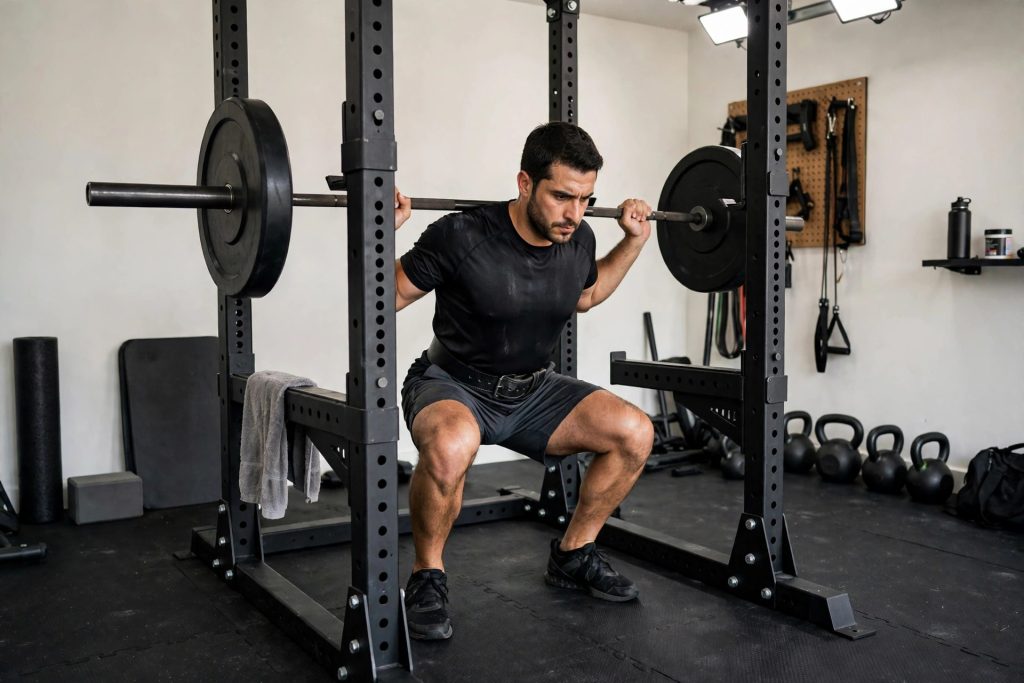
Squat Stand vs Power Rack at a Glance
| Aspect | Squat Stand | Power Rack |
|---|---|---|
| Typical price | $180–$350 | $130–$775 |
| Footprint | ~10–16 sq ft, often portable or foldable | ~25–50 sq ft, permanent |
| Safety | Spotter arms on some models; open design | Enclosed cage with safety bars or straps |
| Solo lifting safety | Good with spotter arms; bail-out space open | Excellent — safeties catch the bar |
| Exercise versatility | Squats, bench, overhead press, pull-ups (some) | Squats, bench, press, rack pulls, band work, dips, landmine |
| Stability | Good; lighter, can shift under heavy loads | Excellent; heavy steel, bolt-down options |
| Ceiling height needed | Low — many fit under 7 ft ceilings | Usually 80"+; tall lifters need 90"+ |
| Best for | Small spaces, renters, portability, Olympic lifting | Serious strength training, solo lifters, long-term gyms |
The Best Squat Stands
| Product | Price | Key Spec | Dimensions | Best For | |
|---|---|---|---|---|---|
| Signature Fitness SF-SS1 Squat Stand | ~$300–$330 | 880 lb capacity, 2×2" 12-gauge steel | 43"H × 45"W footprint | Best Overall Squat Stand | CHECK PRICE |
| Sunny Health & Fitness Essential Squat Stand | ~$200–$280 | 400 lb capacity, independent uprights | adjustable 39.8"–66.9"H | Best Budget Squat Stand | CHECK PRICE |
| PASYOU SR30 Squat Rack | ~$180–$260 | 700 lb capacity, multi-grip pull-up bar | 61.4"H × 49"W | Best Heavy-Duty Squat Stand | CHECK PRICE |
| HulkFit Pro Series Folding Wall Mount Rack | ~$260–$350 | Folds to wall, 800–1,000 lb capacity | folds to ~4" from wall | Best Portable/Folding Squat Stand | CHECK PRICE |
1. Signature Fitness SF-SS1 — Best Overall Squat Stand
The SF-SS1 is the squat stand for people who almost bought a rack: 2×2-inch 12-gauge steel uprights, an 880 lb capacity, a 350 lb-rated multi-grip pull-up bar, and — critically — 550 lb-rated spotter arms included in the box. Most stands make you buy spotter arms separately; here they’re part of the deal, which closes much of the safety gap with a cage.
The H-base keeps it planted without bolting, the bar holder and plate storage pegs keep your area tidy, and the price undercuts most decent power racks. At ~$315 it’s not the cheapest stand here, but it’s the one I’d trust under a heavy bar. If your ceiling is low or your room is small, this is the closest a stand gets to rack confidence.
Key specs: 880 lb rack / 550 lb spotter-arm capacity · 2×2″ 12-gauge steel · spotter arms included · multi-grip pull-up bar (350 lb) · plate storage · ~$300–$330
2. Sunny Health & Fitness Essential Squat Stand — Best Budget Squat Stand
Sunny’s Essential is the minimalist’s stand: two fully independent uprights, 400 lb capacity, height adjustable from 39.8 to 66.9 inches to suit squats and bench alike. No pull-up bar, no storage, no spotter arms — just two rock-solid posts that do one job well.
The honest framing: this is for lifters who don’t need more. If you squat moderate weight, have a training partner or conservative programming, and want the smallest possible footprint at the lowest price, the simplicity is the feature. Independent uprights also squeeze into awkward room layouts where a connected base won’t fit. Just budget separately for spotter arms or a spotter if you train heavy alone.
Key specs: 400 lb capacity · independent uprights · 39.8″–66.9″ adjustable height · small footprint · no spotter arms included · ~$200–$280
3. PASYOU SR30 — Best Heavy-Duty Squat Stand
The SR30 looks like a stand and works like half a rack: 700 lb capacity, a multi-grip pull-up bar up top, dip bars, a landmine attachment, band pegs, and 550 lb-rated spotter arms included. That’s a remarkable accessory list at a ~$180–$260 street price — the accessories alone would cost more bought separately.
PASYOU is a newer brand than Sunny or Signature Fitness, so the long-term track record is thinner, and the 13-gauge steel is a step below 12-gauge. But the review base (1,600+ ratings at 4.5 stars) is real and the feature set is unmatched in this price band. For a lifter who wants maximum capability per dollar in a stand footprint, the SR30 is the value king.
Key specs: 700 lb capacity · 550 lb spotter arms included · multi-grip pull-up bar · dip bars + landmine + band pegs · 4.5★ / 1,600+ reviews · ~$180–$260
4. HulkFit Pro Series Folding Wall Mount Rack — Best Portable/Folding Squat Stand
The HulkFit folding rack solves the hardest home-gym problem: it bolts to the wall (or a stringer), folds flat to about 4 inches when you’re done, and unfolds into an 800–1,000 lb-rated squat station with J-hooks and spotter arms. Garage lifters who need to park a car where they squat swear by this design.
The trade-off is installation: you must mount it into studs or a proper stringer — drywall anchors will not do — and setup takes longer than unfolding a freestanding stand. But once mounted, it’s the most space-efficient serious squat solution on this list. If your gym shares space with real life, this is the stand to buy.
Key specs: 800–1,000 lb capacity · wall-mount, folds to ~4″ · J-hooks + spotter arms · requires stud/stringer mounting · ~$260–$350
The Best Power Racks
| Product | Price | Key Spec | Dimensions | Best For | |
|---|---|---|---|---|---|
| CAP Barbell FM-CS7000F Deluxe Power Rack | ~$130–$190 | 500 lb capacity, 2×2" 14-gauge steel | 54"L × 50"W × 82"H | Best Budget Rack | CHECK PRICE |
| HulkFit Pro Series Power Cage HFPC-1 | ~$300–$420 | 1,000 lb capacity, 2×2" 12-gauge steel | 44"D × 48"W × 84"H | Best Overall Rack | CHECK PRICE |
| Sunny Health & Fitness SF-XF9931 Power Zone Rack | ~$225–$350 | 1,000 lb capacity, multi-grip pull-up bar | 53"L × 49"W × 83.5"H | Best Compact Rack | CHECK PRICE |
| Body-Solid GPR378 Pro Power Rack | ~$599–$775 | 1,000 lb capacity, 3×3" 11-gauge steel | 48"L × 58"W × 82"H | Best Premium/Commercial Rack | CHECK PRICE |
1. CAP Barbell FM-CS7000F — Best Budget Rack
The FM-CS7000F is the cheapest way to get inside a cage: a 500 lb-rated rack in 2×2-inch 14-gauge steel with safety bars, J-hooks, a pull-up bar, and plate storage, regularly selling for under $190. For a beginner or intermediate lifter, that’s an absurd amount of steel per dollar — and the safety bars alone justify it over any stand at the same price.
The compromises are what you’d expect: 14-gauge steel is thinner than premium racks, the upright holes are widely spaced for fine bench adjustments, and the 82-inch height suits most but not all tall lifters. Confirm the listing shows the “Deluxe” FM-CS7000F (CAP sells several lookalikes) before buying. As a first rack, it’s the best value in home gyms.
Key specs: 500 lb capacity · 2×2″ 14-gauge steel · safety bars + J-hooks included · pull-up bar · plate storage · 54″L × 50″W × 82″H · ~$130–$190
2. HulkFit Pro Series Power Cage (HFPC-1) — Best Overall Rack
The HFPC-1 is the enthusiast’s sweet spot: 2×2-inch 12-gauge steel, 1,000 lb capacity, dip bars and a multi-grip pull-up bar included, and a huge ecosystem of HulkFit attachments (jammer arms, lever arms, cable systems) that let the rack grow with you. The 1-inch hole spacing in the bench zone gives the fine adjustments the CAP lacks.
At ~$300–$420 it’s double the CAP’s price but a meaningfully better rack: thicker steel, better adjustability, and an upgrade path that means you may never need to replace it. If you’re buying one rack for the next decade and your space allows, this is the pick that makes the squat-stand question moot.
Key specs: 1,000 lb capacity · 2×2″ 12-gauge steel · 1″ hole spacing (bench zone) · dip bars + multi-grip pull-up bar · attachment ecosystem · 44″D × 48″W × 84″H · ~$300–$420
3. Sunny Health & Fitness SF-XF9931 — Best Compact Rack
The SF-XF9931 threads the needle between stand and rack: a full four-post cage with 1,000 lb capacity and a multi-grip pull-up bar, in a 53×49-inch footprint that’s barely bigger than some squat stands. It’s the answer for lifters who want cage safety but genuinely can’t spare the 60+ square feet a big rack demands.
Sunny’s build quality punches above the price — the powder coat and welds get consistent praise — and the included J-hooks, safety arms, and band pegs mean nothing extra to buy. The 83.5-inch height needs a standard 8-foot ceiling with a little to spare. For apartments and small garages, this is the rack that fits where others don’t.
Key specs: 1,000 lb capacity · 2×2″ steel · multi-grip pull-up bar · safety arms + J-hooks + band pegs · 53″L × 49″W × 83.5″H · ~$225–$350
4. Body-Solid GPR378 Pro Power Rack — Best Premium/Commercial Rack
The GPR378 is what light-commercial gyms buy: 3×3-inch 11-gauge steel — a full gauge thicker than everything else here — 1,000 lb capacity, and Body-Solid’s lifetime in-home warranty. The 2-inch hole spacing is coarse by enthusiast standards, but the rack will outlive your lifting career and probably your house.
This is overkill for most home gyms, and the $600–$775 price says so. But if you’re a strong lifter, you train clients at home, or you simply never want to think about equipment again, the GPR378 is the last rack you’ll buy. Note that accessories (dip handles, extra safeties) are sold separately, so budget accordingly.
Key specs: 1,000 lb capacity · 3×3″ 11-gauge steel · lifetime in-home warranty · 2″ hole spacing · 48″L × 58″W × 82″H · accessories separate · ~$599–$775
Verdict: Which Should You Buy?
Buy a power rack if: you train alone (the safety bars are non-negotiable for solo heavy lifting), you have 25+ square feet to spare, you want one station for squats, bench, press, rack pulls, and pull-ups, or you’re building a gym to last a decade. For most lifters, the rack is the right answer — and the HulkFit HFPC-1 or the CAP FM-CS7000F cover every budget.
Buy a squat stand if: your space is genuinely tight (under ~15 sq ft), your ceiling is low, you’re a renter who can’t bolt anything down, you need to move or store the equipment regularly, or you do Olympic lifts where an open design and easy bail-out matter more than a cage. The Signature Fitness SF-SS1 with its included spotter arms is the stand that comes closest to rack-level confidence.
The tiebreaker is safety. A rack’s enclosed safeties catch a failed rep with zero drama; a stand relies on spotter arms and open space. If you squat heavy alone — and most home lifters do — that single difference outweighs everything else. Stands are excellent tools, but they’re a compromise you make for space, not a preference you choose for performance.
How to Choose Between a Squat Stand and a Power Rack
- Measure your space first, honestly. A rack needs roughly 8×8 feet of working room plus ceiling height; a stand needs about half that. If you’re still planning the room, our guide on how much space you actually need for a home gym walks through measuring for racks, stands, and everything around them.
- Weigh safety against footprint. Solo heavy lifting is the rack’s killer feature. If you’ll regularly squat or bench near failure alone, the cage’s safeties are worth rearranging furniture for.
- Check your ceiling. Most racks stand 82–90 inches tall — fine under 8-foot ceilings, tight under 7. Many stands adjust shorter, and folding wall-mount racks dodge the issue entirely.
- Think beyond squats. A rack anchors band work, dips, landmines, and cable attachments; a stand mostly holds a bar. If you’re also shopping for leg work, see our picks for leg press machines for home gyms — several pair well with either station.
- Consider your floor. Heavy racks (especially 3×3 steel) want rubber flooring and ideally bolting; lighter stands are kinder to apartment floors. Factor flooring into the budget either way.
- Budget the accessories. Spotter arms, dip bars, and storage often cost extra on stands; racks more often include them. Compare the out-the-door price, not the headline price.
FAQs
Can I bench press with a squat stand? Yes — set the J-hooks to bench height and you’re good, and stands with spotter arms (Signature Fitness SF-SS1, PASYOU SR30) give you the same safety net as a rack for benching. The limitation is stability: a very heavy bench press can rock a light stand, so make sure yours is rated well above your working weight and consider a model with a wide H-base.
Is a squat stand safe for heavy squats? With the right stand and setup, yes. Choose a stand rated well above your max, always use spotter arms when training alone, and learn to bail safely — the open design actually makes bailing easier than a cage. That said, a power rack’s enclosed safeties are inherently more forgiving, which is why heavy solo lifters usually graduate to a rack.
Do I need to bolt down a power rack? Not always, but it depends on the rack and the lifting. Heavy 3×3 racks are stable unbolted for most work; lighter racks can walk during aggressive rack pulls or kipping pull-ups. Many racks include bolt-down tabs — if yours does and you own the floor, use them. Renters should choose a heavy flat-foot rack or a stand instead.
Can a folding wall-mount rack replace a full power rack? For squats, bench, and press — yes, a good folding rack like the HulkFit is just as strong as a freestanding rack when properly mounted. What you lose is the cage’s interior: no rack pulls from low pins, less room for band and cable attachments, and no walk-in convenience. If your priority is reclaiming floor space between sessions, the trade is worth it; if the gym is permanent, a full rack does more.